Inspiration

I’ve just been scrabbling around in my stash looking for a particular ball of yarn.  I have a plan for it and I’d like to try a little sample.  While I was sorting through the six large boxes of stash that lurk under the stairs, I knocked the top of a hatbox (containing drum carded fibre all ready for another project) and stuffed in with the fibre was a large bag of dried lavender flowers.  I’d been looking for that before Christmas.  I bought it during the summer and knew I’d put it in with my stash (it may as well be deterring moths while being stored) but then I couldn’t figure out where in my stash I’d popped it (I thought it was with some fibre stashed under the bed).

While writing this I’ve realised that I’ve got quite a lot of stash (under the stairs, under the bed, fleece in the garage and utility room) and quite a bit of craft equipment dotted around the house (in my “study” equipment is contributing to the problem of accessing my book shelves and I have two spinning wheels in the bedroom).  It’s rather lovely to be surrounded by the means and the supplies to make things.  All I need to add is inspiration and time!

logo

Last but not least

A little while ago I said my bamboo shawl was finally finished and off the loom.  It took another week or two, but I eventually tackled trimming the fringe (I can thoroughly recommend checked table-cloths for this activity, with a towel on the item to hold it still while cutting).

trimming

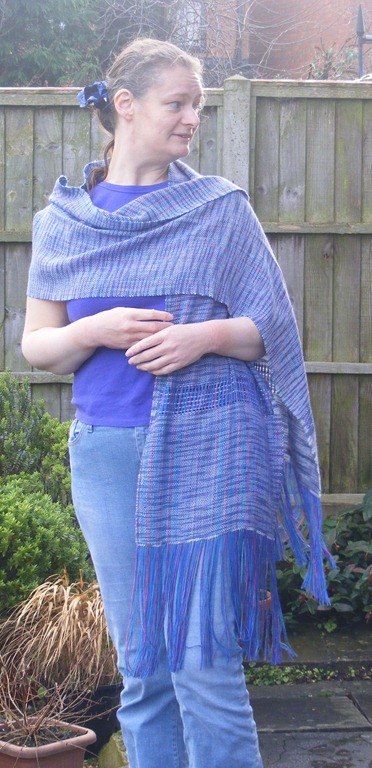
I then asked my Mum to be my photographer (thank you Mum!) while we stood outside in the surprisingly mild January sunshine.  As you can see in the first picture, the start and the end of the shawl are at a very different gauge.  However, I’ll never wear it like this.  As you can see in the second picture, the difference doesn’t matter.

front_bothfront

I really like the way that the fabric drapes.  It’s lovely and soft.  However, the bamboo is very slippery and for a future project I would like to combine it with wool for a more stable fabric.

I know that you are now in shock – three finished objects all in a row (ok, I know one wasn’t really mine)!  Don’t worry, normal service will be resumed with only WIPs and UFOs for quite a while!

Sparrow Wings

I’m lucky with the spinning; if I finish a yarn I don’t want to use, then I know plenty of people the yarn can be passed onto.

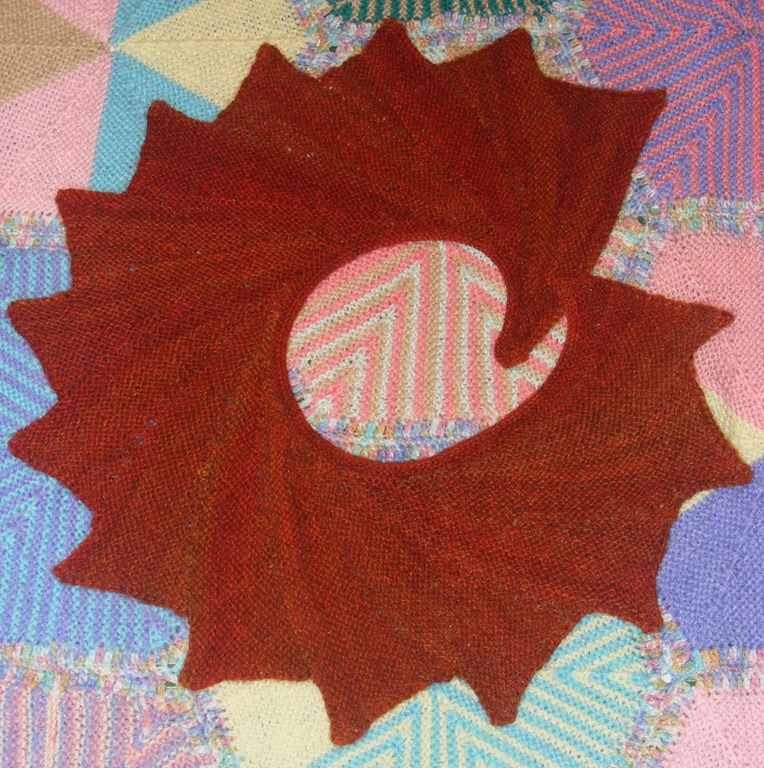
When I finished my BFL I knew that I didn’t want to make anything for me with it.  The yarn was lovely and everyone else loved the colour.  So I gave it my mum.  In no time at all she’d knitted a mini-wingspan with it:

sparrow

She cast-on half the number of stitches specified in the pattern and worked until the yarn had almost run out.  She then worked an i-cord cast-off on the neck-edge of the resulting shawlette.

We love the way the pattern shows off the subtle colour variations in the yarn.

Rare, very rare and a couple of firsts!

If you look at the categories for this blog and find “Projects – Completed” there are, at the time of writing this, exactly 7 (and one of those is an Almost Finished Object, and some others are skeins of yarn).  So an actual finished garment or accessory is a rare thing.

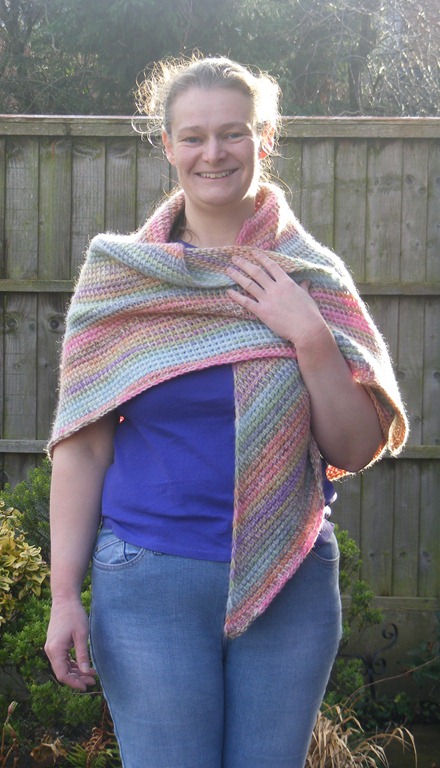
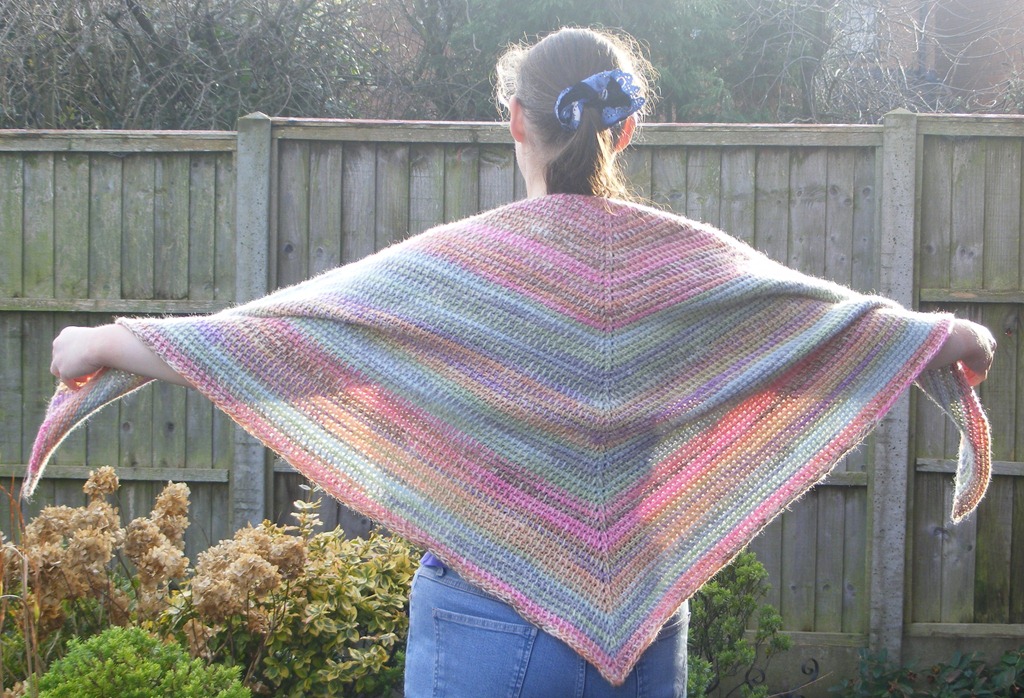
Even more rare is that this took me only 10 days to make!  Most projects take me years.

And the firsts?  It’s something for me to wear (I’m wearing it now in my study while I type this)!  I have made things for me to wear in the past – but they predate this blog by years and are also very rare.  The other first is that I’m modelling it:

frontback2

back1

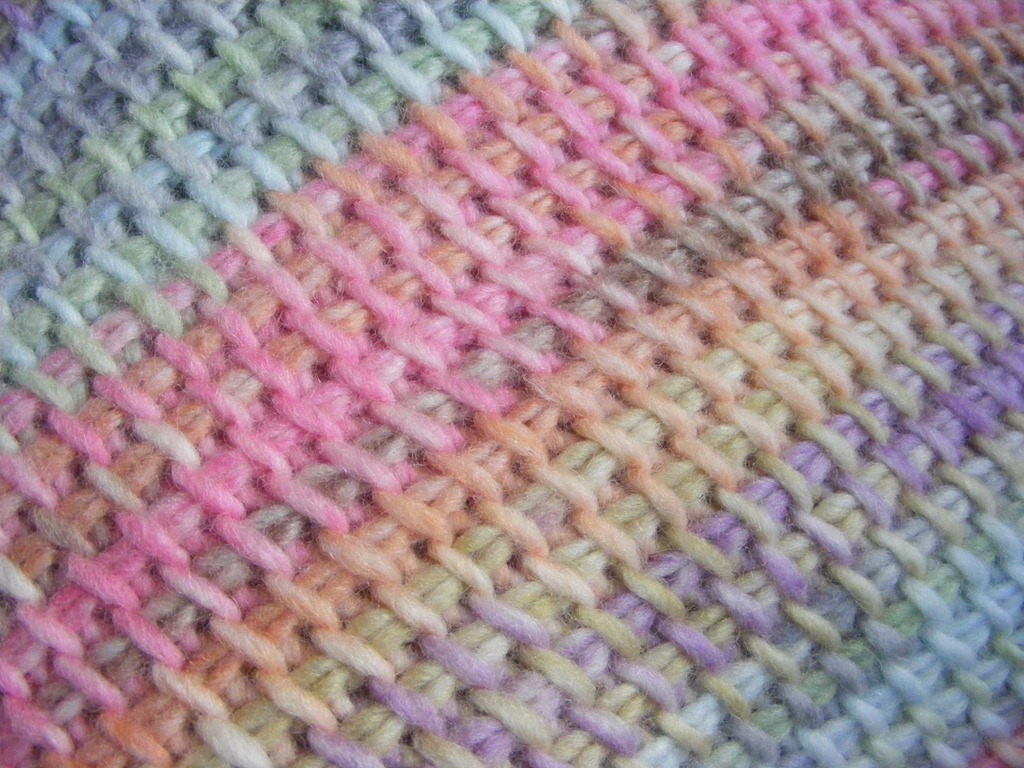
Now you’re recovered from the shock, here’s a close up of the Tunisian crochet:

colour

I really love the way the basic Tunisian stitch makes the colours of the variegated yarn work.  It allows the colours to mesh together in the same way that weaving does, and therefore makes them more complex.

The stitch itself is quite strange.  If you look closely at the fabric you’ll find that it’s a knitted fabric with a chain stitch wrapped around each knit stitch.  The bars you can see in the picture above are one leg of the knit stitch, the other leg is wrapped within the chain stitch. (So the chain goes both through and round the knit stitch).

On the back of the fabric (not shown here) you’ll see the classic bumps of reverse stocking stitch, but between each pair of rows there bumps from the back of the chain.

Working Tunisian crochet requires a hook that is much larger than you would normally use for knitting or crochet.  To work this chunky yarn I used a 10mm hook – even though the ball band recommended a 6mm needle.

I enjoyed working on this.  I enjoyed the speed and simplicity of the project.  I also love the feel of the finished fabric.  I think there will be more Tunisian crochet projects in the future.

Tunisian Shawl

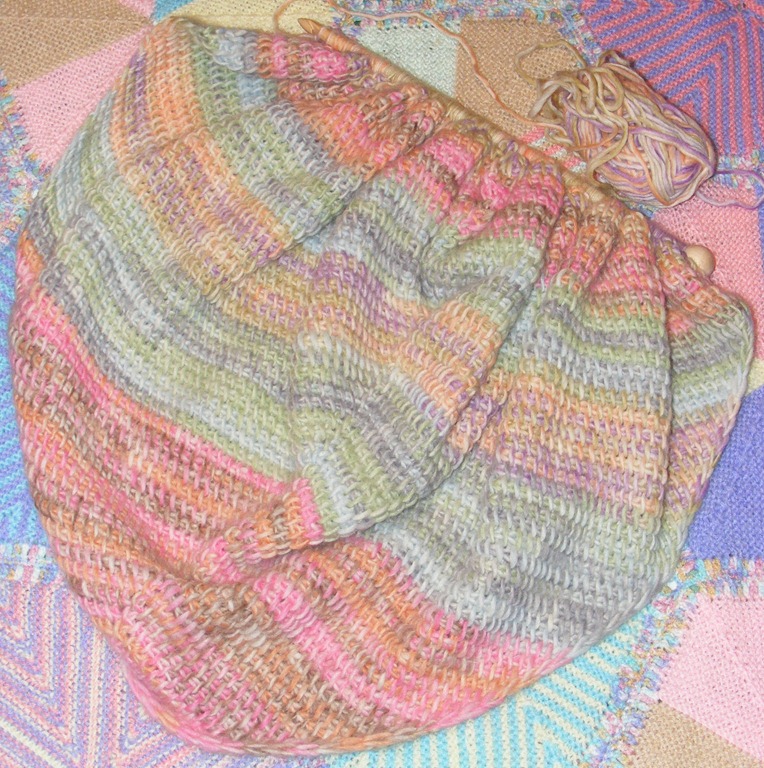
The Tunisian Crochet Shawl continues to grow. So far it’s proving to be a fast project.  I’m finding time everyday to spend working on it, and the yarn and technique make for quick results.  So, I’m already on ball six of eight.

It is being worked in Paton’s Eco Wool Chunky in three different shades.  I love the way that the Tunisian Simple Stitch makes the colours work in the yarn.  However, I had to laugh when I read the inside of the ball-band:

“… has a unique Home Spun character with a soft and lofty handle.”

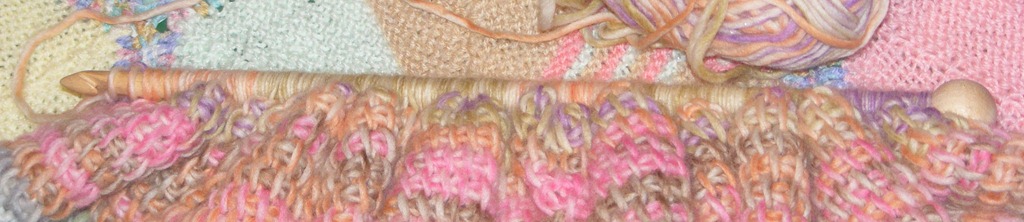
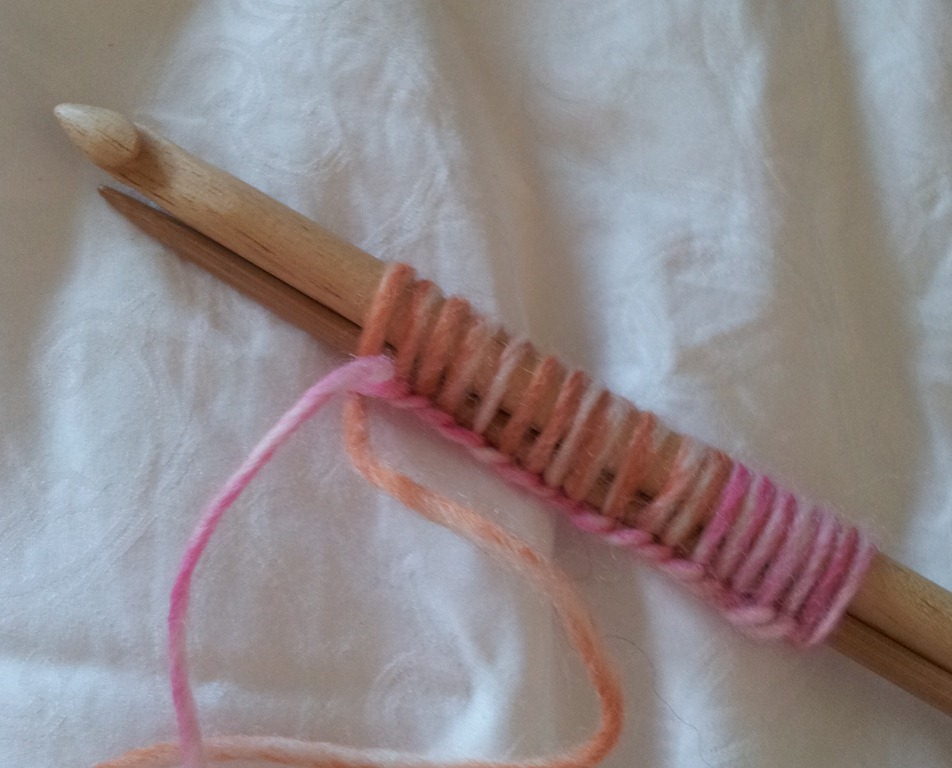
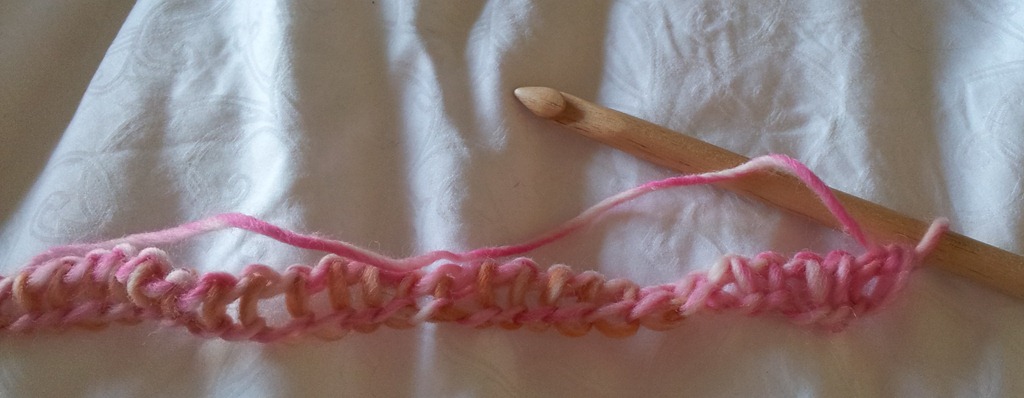
Here is the shawl with all the stitches picked up ready for the return row:

shawl 

I’m now desperate for the hook that goes on the knit-pro cable.  However, it hadn’t arrived before I went away for a few days.  I don’t know how much more I can crochet without it:

shawl-picked-up

… and changing plans

I started tricoting (I may have just made that word up) a scarf last night, and really liked it.  This morning I wasn’t so sure.  It lacked something, but I liked the way the stitch and yarn worked together.  I was also concerned about the number of balls of yarn I have (8) and the likely length of the scarf (very long).

I tried a wider scarf, but still wasn’t struck.  However, I liked the look of a shawl in the book I’m using (though there isn’t a pattern for that shawl), so thought I’d try that instead.

shawlinprogress

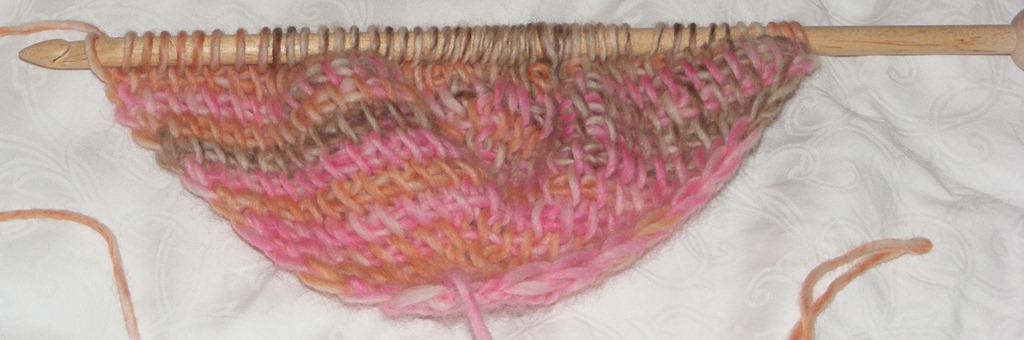
I started with five stitches (see notes on casting-on below) and I’m increasing in the same places I would if I was knitting this shawl – increase at each edge and two increases round a centre stitch.  The increases are worked on every forward (pick-up) row (including the first one).

Now then.  I do have an impending problem:

stitches

I don’t know how big I can make this shawl before trying to cram all the stitches onto the needle becomes too difficult.  Now I’m a huge fan of circular needles and interchangeable circulars and own a few tricot hooks to which a cord can be added.  So I didn’t think I had a problem… but the maximum size of hook that knit-pro do is 8mm.  Or at least that’s what I thought – but I’ve just found a supplier who does 10mm and 12mm in the acrylic… so I now have those on order (I wonder when they’ll be shipped).

Hazel’s Tunisian cast-on

To cast on Tunisian crochet the books all say work a chain, and then pick-up stitches along the chain.  Not having done much crochet I find I sometimes twist the chain when picking up stitches from it (which I find results in a messy cast-on).  However, there is a knitting cast-on that uses just one needle (and it’s a cast-on I use regularly).

casting-on

Here’s the 10mm tricot hook with a 5.5mm knitting needle held next to it.  I found this gave a good size for the initial stitches.  The cast-on I’ve used is long-tail cast-on.  Once the first row is completed (the reverse or cast-off row completed) the tricot can be pulled to open up the cast-on stitches:

first-row-complete

Work can then proceed as normal!

Getting distracted

Today some new reeds arrived for my new 24” rigid heddle loom.  Have I mentioned my new loom? Here it is, being put together a few weeks ago:

loom

An additional reed for my 16” loom also arrived.  With two looms empty my mind turned to getting the next projects on them, so I fished out my boxes with my “weaving” yarn in (I don’t think I’ve got a good criteria for it being weaving yarn – just that I think it’s more likely I’ll weave with it than anything else).

I played around with some colours together (I’m thinking cushions for the lounge) but wasn’t feeling inspired.  Then I spotted some “knitting” yarn in another box and my tricot hooks/needles (are they needles or hooks? nooks?  heedles?), and before I knew what was happening I was running up a quick sample (and liking it).

So, that’s one scarf in tricot from chunky eco wool in various subtle colours in the queue.  The weaving’s still on the starting blocks.

I’m also liking this Sherlock Hat in the latest edition of Knitty.

A finished object

Now here’s a rarity on here.  A finished object.  Well, at the moment it’s an almost finished object as I need to trim the fringe, but close enough!

Last night I did the last few picks, hemstitched and removed from the loom a shawl made from bamboo sock yarn.  Today I tided up some ends and washed/finished it.  This is the first proper project I’ve made on my 16” rigid heddle loom.  And as a first project here are some things I’ve learnt:

  • Don’t be too ambitious.  A first project should be quite short, a scarf or a cushion cover perhaps.  As a first project it’s likely that the gauge of the weaving will change (on this shawl there’s a noticeable difference in the number of picks I was working at the start of the piece and the number at the end).  I, however, ignored this advice (it’s in all the books) and put a warp on for a long shawl.  When I removed the shawl from the loom, I was shocked just how long it is.
  • Despite the fact that weaving is fairly quick, I can still take well over a year to finish a piece.
  • I should place markers as I go, so I know how long the piece is and can make a sensible decision on when to start the end border design (if that’s what I’m doing).  In the end I sort of guessed at how much was still on the back roller (knowing the length of the paper wound onto the roller helped a bit here).
  • Placing paper into the front roller (as the finished weaving is wound on) really improves the tension and makes subsequent weaving easier.  However, once the weaving is finished (i.e. washed), there’s no noticeable difference – but it does look better on the loom.
  • Sampling is a good idea.  If I’d sampled the pattern I was planning, I may have chosen to work the leno in a different way (there are some very long threads in the leno section that are quite likely to catch).
  • A dessert spoon is just the right weight to use when repairing a broken warp end.  It’s also the perfect shape!
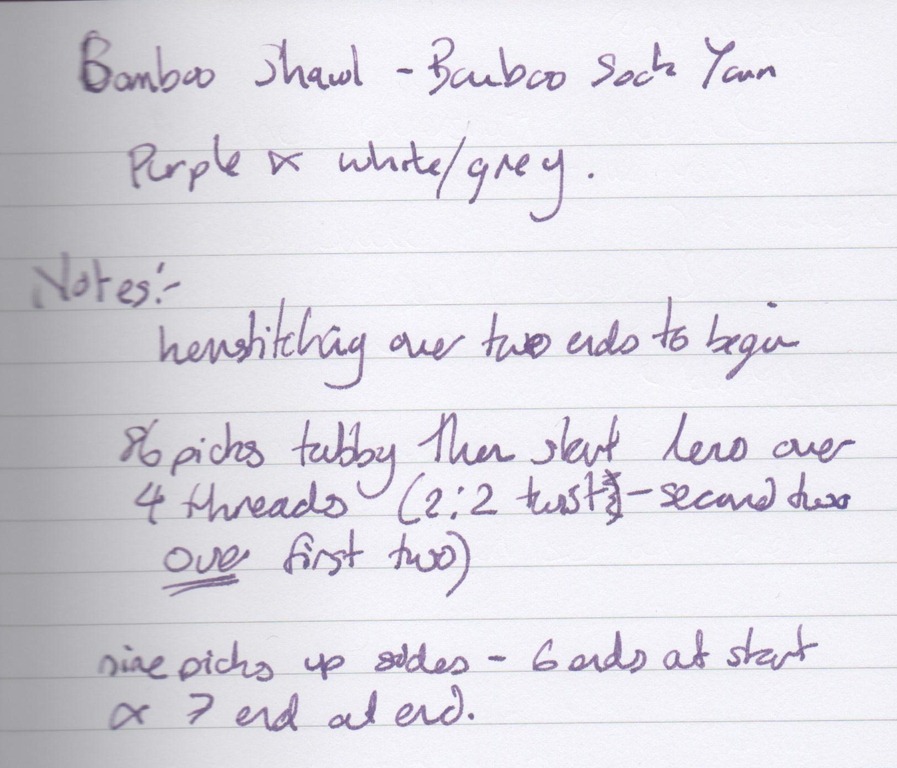
  • Make better notes.  In fact make much, much better notes and also take lots of photos, just in case.  Here are my notes, written in my weaving book (yes, that’s really all I wrote down):

shawl notes

  • Some things I should have written down:
    1. Length of warp
    2. How many ends of warp
    3. The DPI of the reed/heddle
    4. Notes on the yarns (including composition and washing instructions – keeping the ball band would do)
    5. Which yarn I’d used for the hemstitching (e.g. warp or weft)
    6. Both the number of picks and ends that the hemstitching is over (a photo would also be helpful here)
    7. How long the section of weaving was before the first leno section (at least I’d noted the number of picks)
    8. Kept a photo of the leno work (and printed it out for easy reference).

I’m sure there are other things I have learnt and more things I should have written down, I may add to the list later.

In the meantime I bet you’d like to see a picture of my shawl?  Well, as soon as I’ve finished the ends, found some sunshine (hmmm, it’s 4 days to the shortest day of the year…) and made a decision on whether to drape the shawl gracefully over a chair or model it myself (which will require finding a photographer) I’ll post up a photo…

Spindle spun Blue-Faced Leicester

Firstly a quick update.  In my last post I mentioned that my phone was languishing in a bag of rice.  I don’t know if it made a difference, but my phone survived. Hurray!  Here’s the stash:

stash

Now, onto the Blue-faced-Leicester.  I dyed the tops at the start of this year.  You can see me starting to spin it in January.  So, after months and months of spindle spinning (not constant spinning, only occasional spinning) I’ve plied together two spindles worth and have a lovely skein of yarn.

The singles:

singles

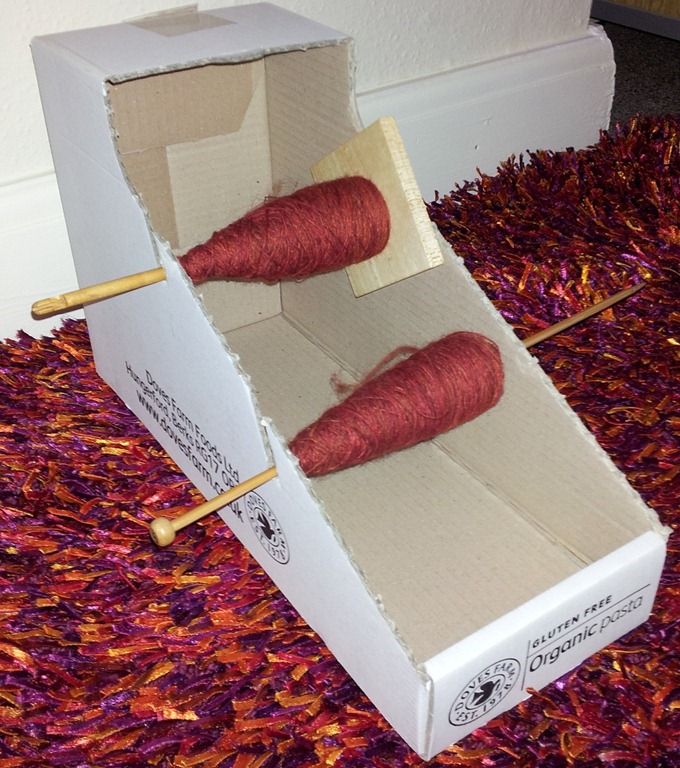
I made a box lazy-kate.  It’s “designed” to take the spindle or knitting needles (I slid the first spun cob onto a knitting needle).  The spindle occasionally fell out as the cob was unwound, but the knitting needle worked brilliantly.  I’m keeping my free lazy-kate for future plying projects.

kate

I plied over a couple of evenings on my Dryad wheel.  The second cob had a lot more yarn (by length, not necessarily by weight) so I finished off by Andean plying (I didn’t get into too much of a tangle and at one point discovered that the bed-knob at the bottom of the bed was a great holder for the resulting bracelets of yarn).

wheel

Sadly, it’s November.  It gets vaguely lighter at about 8am and is dark again by about 4pm.  The last few days have been ones where the lights have stayed on all day in the house.  Even at noon.  So in the end I bowed to the inevitable, and photographed the final skein in the warm glow of artificial light:

skein

I may be a little quiet for a week or two – as paid work will take priority. If I do post tell me to stop procrastinating and get on with my proper job Smile.  I’ll be back soon…

Stash!

Well I was going to include a photo I took earlier today of some stash that had just arrived by post.  An jumble of bags containing a lovely assortment of colours of dyed Shetland.  There were also a couple of bags of Merino: some pretty blended tops and a plain colour to co-ordinate.  These are my first forays into commercially dyed tops.  It turns out that it’s possible to buy Merino wool from flocks whose sheep are not mulesed (up to now I’ve avoided Merino and concentrated on wool from British sheep).

However, I took my photos on my phone.  Earlier this evening I tried juggling a mug of water and my phone, at the same time.  Sadly the water won and landed all over my phone. Surprised smile  Currently the phone is sitting in a warm place in a bag containing some rice.  I’ve no idea if this works, or indeed how wet the insides of my phone got.  But I have 18 months of contract left and don’t really want to buy a new phone just yet, so I’ll cross my fingers and leave it in the warm for a little while longer.Fingers crossed