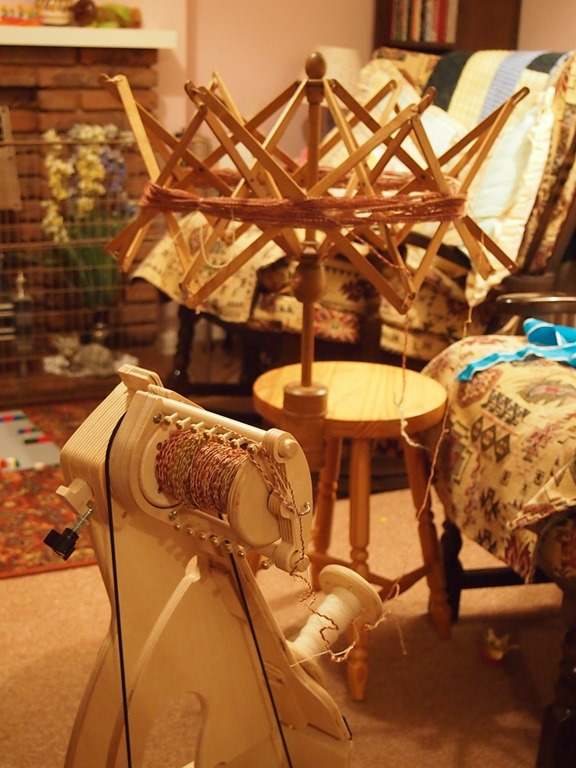
Tour de Fleece: days 3, 4 and 5

Days three and four of the tour have gone well.  Monday was a busy day with all the usual grocery shopping and other general Monday shenanigans.  When time allowed I continued with the spindling and in the evening I made a little more progress on the lovely Juno fibre.

Yesterday (day four) turned into a bit of a bumper spinning day.  In the morning was my son’s sports day.  I took the “fruit salad” spindle spinning and between cheering him on and taking photos I was able to do quite a bit of spindling.  My spinning did get a few enquiring looks from other mums and some questions from one of the older children who was helping with the sports day organisation.  I think I may need to put together a short one page introduction that can be given out at similar events if people are interested.

tdf4-fruit

Also in the morning a new spinning book arrived.  I spent the day flicking through it and in the evening I had to have a go at core spinning.  I carded up a batt with natural white Shetland, a little commercially dyed Shetland, some food-colour dyed Jacob and some sparkly trilobal.
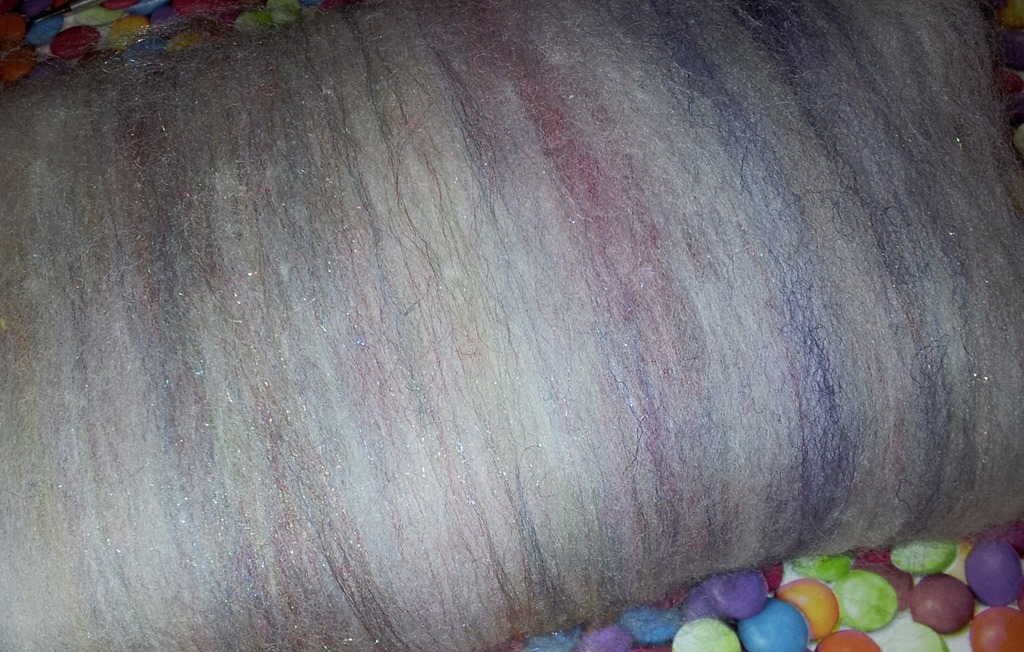
batt

I enjoyed the spinning and ended up with a very light and airy yarn.  In fact I found the lightness compared to the bulk of the yarn really surprising.  I’ll be interested to see how it wears.

spun

This morning I wound it into a ball.  Normally I use a ball-winder – but large yarns don’t work on a standard sized ball-winder, so I had to use a makeshift nostepinne.

ball

Yes, it’s an almost empty kitchen roll.  I’m going to Fibre-East in a few weeks.  I must remember to look out for a proper nostepinne while I’m there.

I’ve knitted all 31 yards up into a small Mobius cowl using 20mm needles.  I just need to graft it and it’ll be complete.  As yet though, I haven’t managed any actual spinning today. So please excuse me stopping here as I must now go and do at least a few minutes!

Tour de Fleece–Day 2

The sun is currently setting on day two, and an absolutely stunning sunset it is too (sadly my photography skills have never been up to capturing the beauty of a sunset, though if I keep trying maybe one day I’ll succeed)!

day2-sunset

Today has been filled with the palaver of installing an integrated dishwasher into the kitchen.  It entailed three trips to local hardware stores before the right bits of waste pipe were sourced and there was further bodging (technical plumbing term) to fix a leak right the end of the day.  However, It is now installed and running and appears to be a huge improvement over the old one.

I failed to keep up with the spindle spinning today.  However, at one point I needed to escape and quietly exited the kitchen, found fibre, went upstairs and dusted and oiled the Dryad wheel.  I then managed a few minutes peaceful spinning.

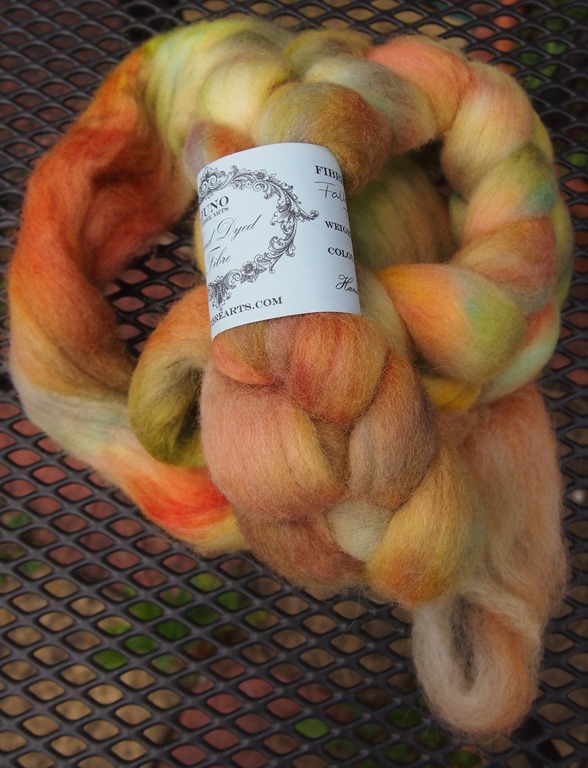
I’m spinning some Falkland dyed by Juno Fibre Arts.  It’s a real treat to spin something dyed by someone else.  The colours are different from the ones I would have chosen and the distribution and proportions of colours are also different.  I’m looking forward to seeing how this will come out.

fibre

I think I’ll Navaho ply it to maintain the changing colours.

day2-juno

Right, the sun is almost gone, so I think it’s time I grabbed another cup of tea and did some more spinning!

Tour de Fleece Day 1

Today saw the start of the Tour de France (apparently – I haven’t watched any or even caught up on events via the internet or radio).  It also saw the start of the Tour de Fleece (TdF)!

Yesterday evening I got myself all prepared and set up my “stash” on Ravelry for the yarn I’m planning on spinning during the TdF.  There are projects that are in progress and some are new projects to spin.  Once I had everything listed I was quite shocked to see how much I’m planning on doing!  I also updated my Ravelry profile with my aims for the TdF.

Today has been a busy day with the children, so I haven’t had time to do much spinning.  Last night I decided that the best way to tackle spinning today was to concentrate on spindling.  So I made sure that the two active spindle projects were easy to grab in quiet moments (there were a few – not many – but some) and I was able to make noticeable progress!

Both spindles already had some singles on, but here was progress by the end of the day:

tdf-day1

This evening I’ve sat down at my Ashford Traditional with the lace flyer and made some progress on the Shetland/Soybean blend that I started nearly two years ago!

I’m looking forward to getting lots more spinning done over the next few weeks and seeing just how much I can do when I prioritise spinning over other non-essential activities.

Ingredients

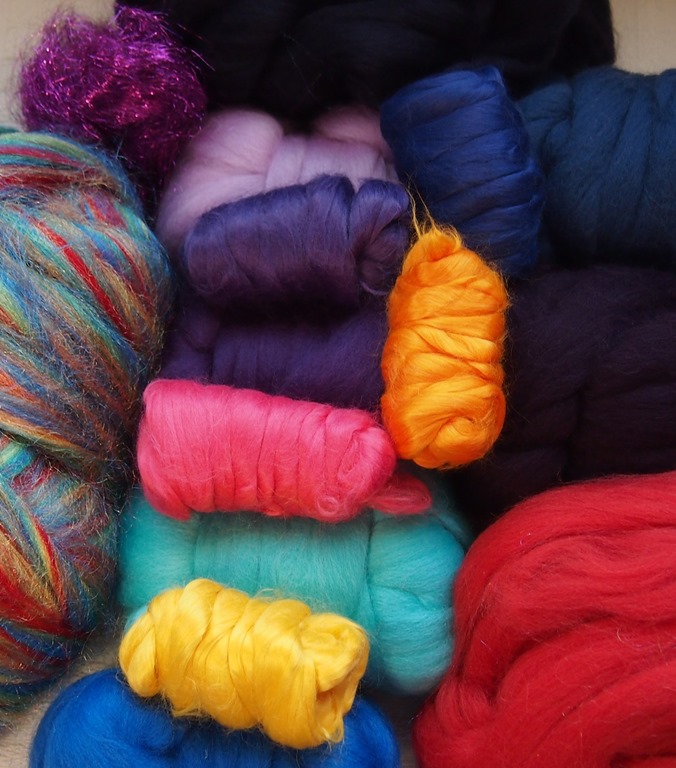
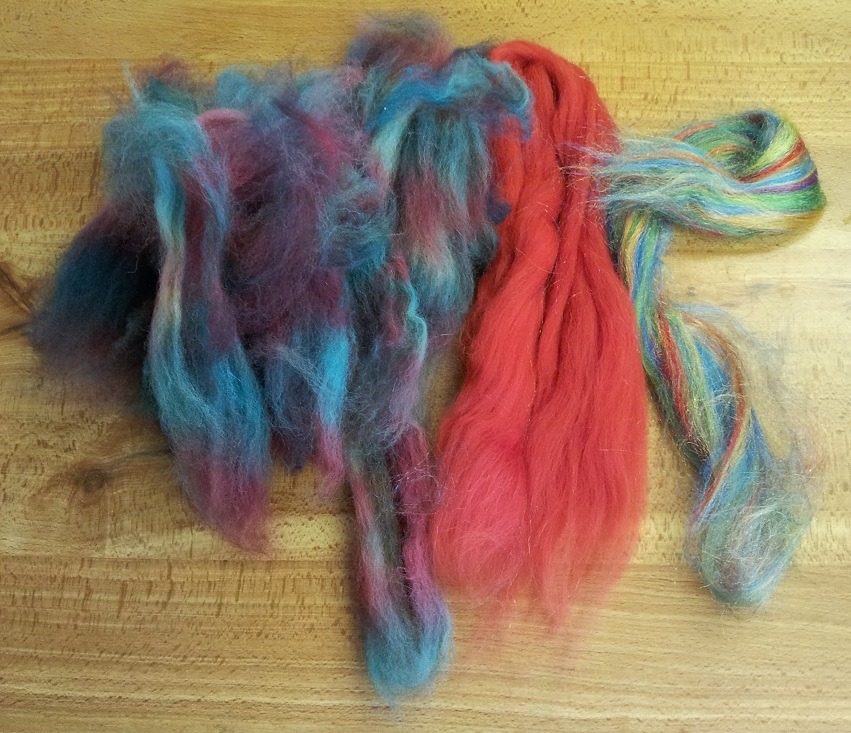
I’ve been playing with colours of fibre (wool, bamboo, trilobal and angelina) and have some possible ingredients for “Bow Ties are Cool”:

ingredients

I’m not planning on using these proportions though.  I’m thinking of a base of dark colours with brighter colours acting as highlights.  I may also need to add or take something away.  Looking at the photo the fibres I’ve chosen are very smooth – I think I need some texture in there too (perhaps the rest of the Leicester Longwool locks)?

Anyway, this looks like it will be fun!

Challenges

My life has definitely been full of challenges over the last couple of years (they’ve not been fun, but I think I’m stronger for them).  However, I have two challenges coming up that I’m really looking forward to.

Firstly, I’ve been invited to be a guest blogger on the Creating Space blog.  When I write here I’m talking about my creative journey (and sometimes I manage to discuss techniques and my wheels).  To write on someone else’s space I need to think about the readers there and write something that reflects the group (rather than just me).  This will mean that I have a slightly different focus from when I write here, but I’m looking forward to meeting the challenge.  When I’ve worked out what I’m going to write, written it, and the post has gone live, I’ll post a link here 🙂

Secondly, I’ve signed up for the Ravelry Tour de Fleece (TdF).  This is an annual event that runs while the Tour de France is on-going.  I’ve joined two teams: Ashford UK Spinners and Team TARDIS.  The objective is to spin everyday that the Tour is running – with two rest days and a challenge on the day of the hardest stage.  I’ve been trying to keep my aims low-key to fit with my current situation.  So here they are:

  1. Spin everyday!
  2. Do some spinning on all of my wheels!  Not everyday obviously, but I should do some spinning on each of my wheels by the end of the TdF.
  3. Spin a fun Doctor Who inspired art yarn.  I intend to learn a new technique while doing this.  I may spin something inspired by “Bow Ties are Cool” or “Wibbly Wobbly Timey Wimey”, but I may do something entirely different :-)  Yes, it is a bit silly, but it’ll be fun, I’ll learn and perfect a new technique and I’ll end up with a scarf that I can wear to an SF Convention should I ever make it to one!
  4. Finish off any languishing projects.  I have a number on both wheels and spindles.  On my wheels this is an achievable goal but on my spindles I hope to make progress.

Once I’ve finished the “in progress” projects I have quite a lot of fibre all lined up for projects.  I have 10oz of carded Soay-cross fibre that I need to spin into a yarn for a shawl, plus a number of hand-dyed tops and a multi-coloured merino top.

The TdF is often a chance to de-stash a little.  However, I’ve been so overcome with enthusiasm for art yarns since my success with the Wild and Independent yarn and scarf, that I’ve ended up ordering more stash!  There’s lots of sparkle, un-combed fleece and also some bamboo and wool tops from different breeds for me to try.  As you can see I didn’t even manage to contain my enthusiasm to a single order:

TdfStash

The TdF starts next Saturday (29th June) and runs for three weeks. I’ll update progress on Ravelry and Instagram daily and post regular, but not daily, updates here.  Wish me luck!

Locks and Labels

I’ve crammed lots of spinning and knitting into the last few weeks.  But first a mystery!

I was away for a few days and took my portable wheel and a small selection of tops to spin.  I eventually decided on an pink/orange top that I’d dyed.  After dyeing it I remember thinking that I would know what it was when I used it and so didn’t add a label.  However, for the entire time I was spinning I wasn’t sure of the fibre.  It was humbug tops but that’s all I knew.  Was it Shetland or BFL?  I didn’t have a clue!  When I got back from my trip I checked my blog and thought that maybe it was some BFL humbug tops that I’d dyed.  But apparently I’ve already started spinning that into a crepe yarn!

I’m going to have to start making notes on the dyeing that I do and also adding labels to both my dyed tops and to the finished yarns.  However, I Navaho plied this mystery into a lovely yarn of about 190 yards.

navaho

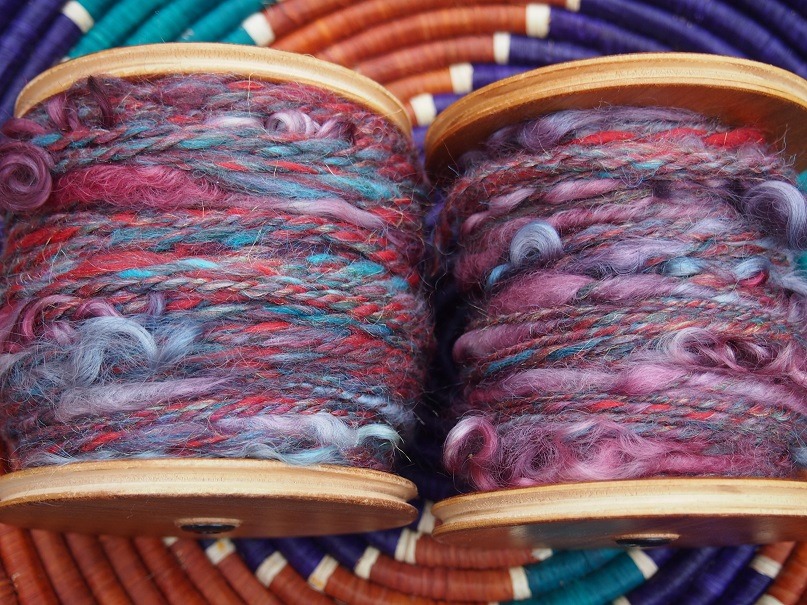
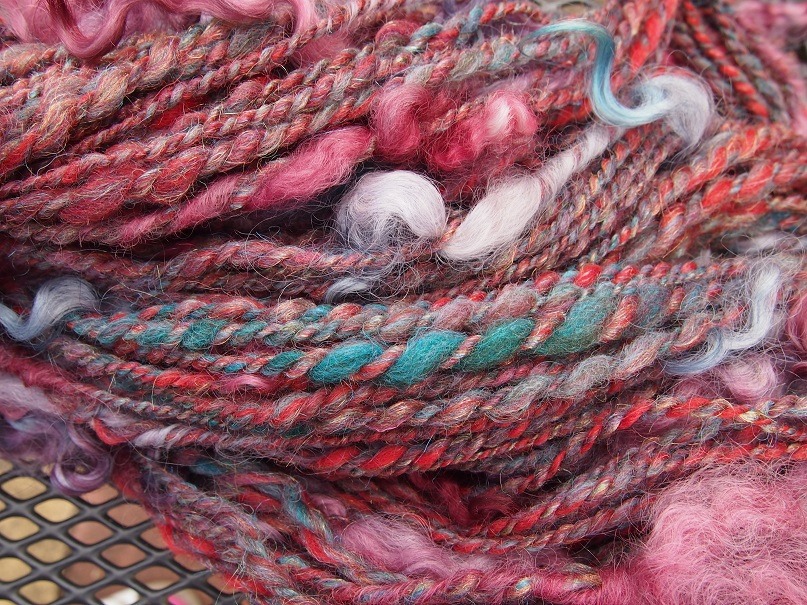
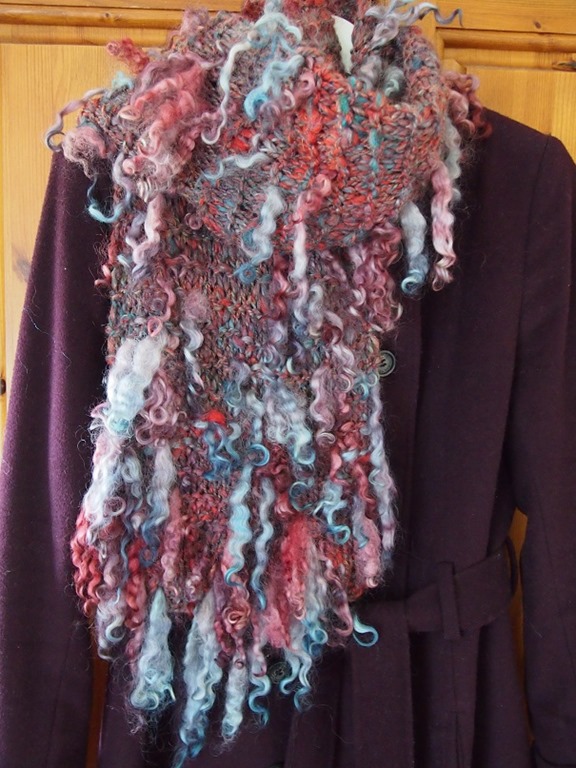
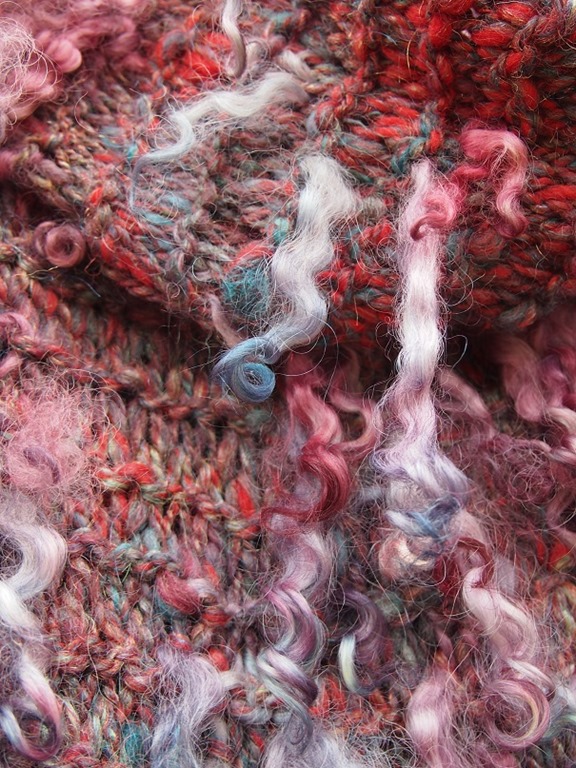
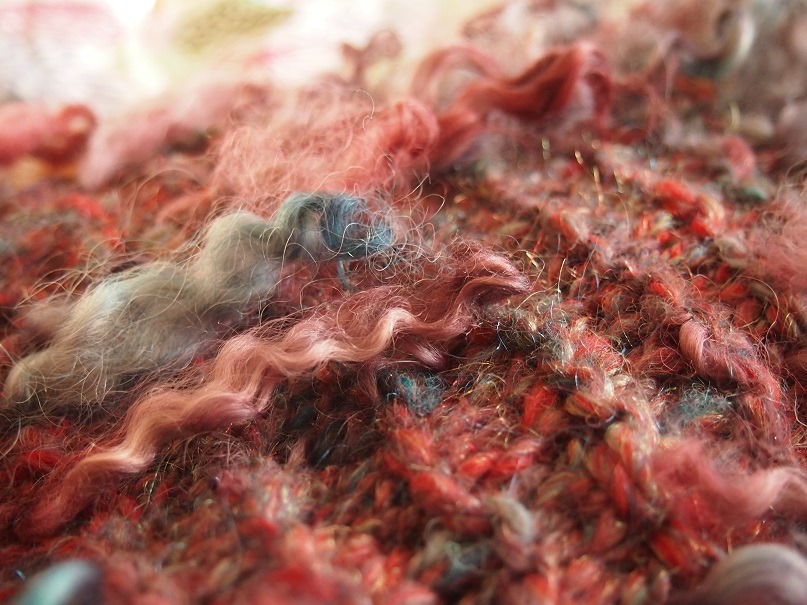
I’ve also continued with the Wild and Independent yarn that started as a response to the suggestion I should downsize my spinning wheel collection.  I had enormous fun spinning this big yarn and plying in the locks.  I also really enjoyed knitting it up into a crazy scarf.

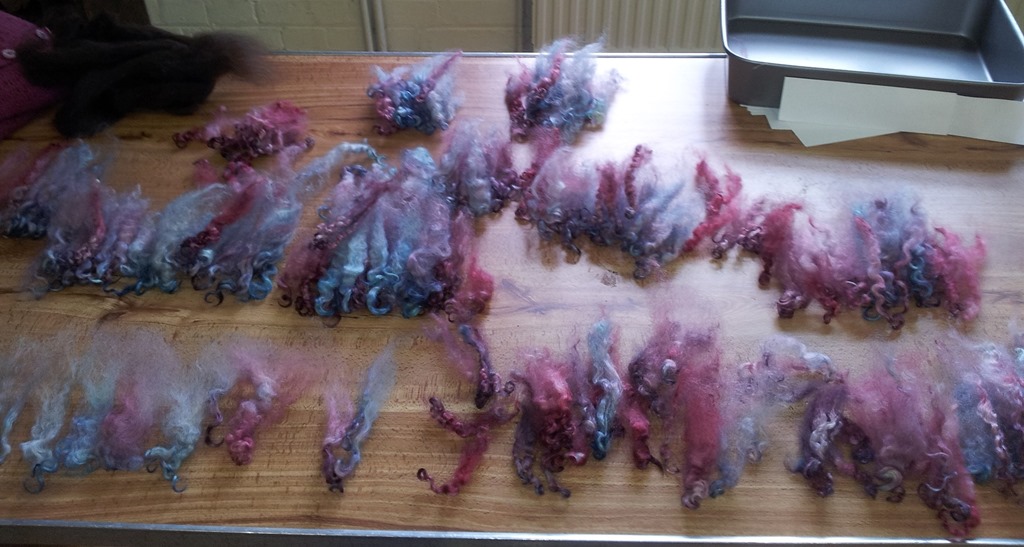
I took advice from my friends at Creating Space and settled on making a two-ply yarn with the locks trapped between the plies.  I did try tail-spinning the locks during the plying but I couldn’t quite get that to work.  In the end the locks are partially tail-spun and partially encapsulated by the plies.

locks

wild-bobbins

wild-yarn

I then proceeded to knit a huge scarf in just a few evenings. 

wild-coat

wild-scarf-close

wild-scarf-closer

I plan to wear my wild and independent scarf at every opportunity.  During the summer I’ll wear it when spinning in public (I’ve never got enough layers on when spinning in a field) and during the winter I’ll wear it with my military style wool coat (military and wild – a great combination).

I have plans to make more wild yarn – for my next one I have some locks in pink, yellow and orange ready to use!

Wild and independent

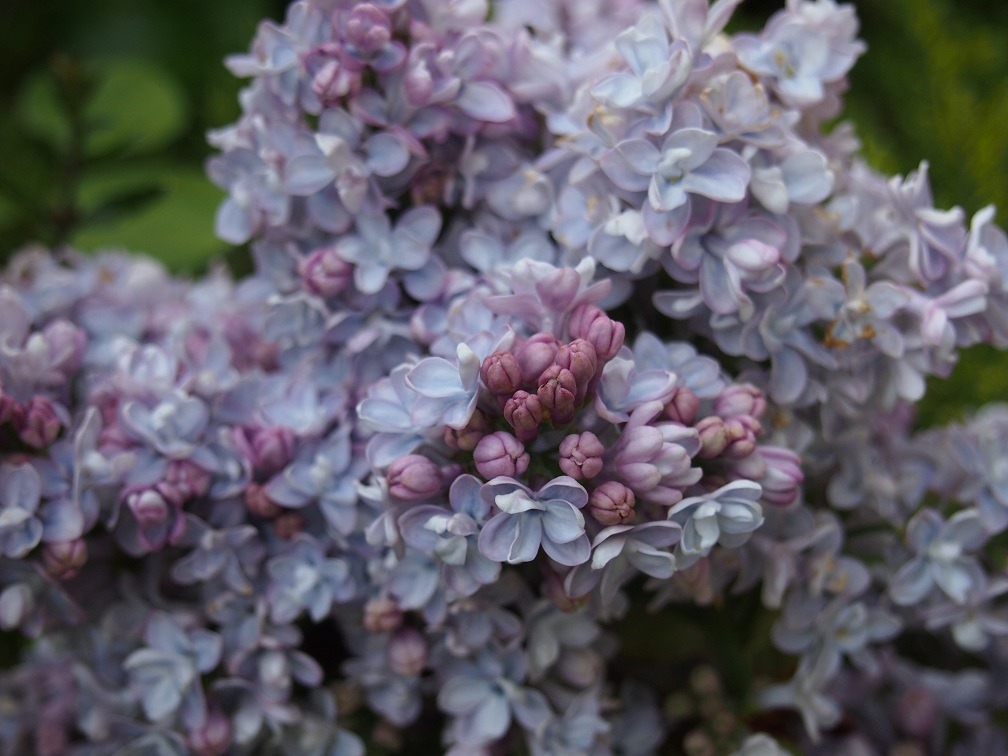
Today has been a lovely day. The rain has stopped and the sun has appeared. The apple and lilac trees are still in blossom and the Horse Chestnuts are decked with their candles of white and dark-pink flowers.

apple

lilac

The best part of today though, was getting some carding and spinning done in the company of other very creative people. A day filled with spinning, weaving, sewing, quilting, carding, painting and knitting. It was a positive delight of colour, shape and texture. I went along with my car filled with tools, equipment and fibre, but no real idea of what I was going to do. After getting myself settled (which always means getting a cup of tea) and sorting through my boxes I was starting to see the beginnings of some inspiration.

I wanted to spin something “wild and independent”, as was suggested by Lyn following my last blog post. After discussing this on Ravelry I’d decided that locks and glitter wasn’t too over the top – but I still wasn’t sure what I was going to spin.

In the end I decided on some Shetland humbug tops I’d dyed, but the original tops had been a disorganised mess and really needed carding to make them usable. To this I added some commercially dyed “poppy” Shetland and some rainbow trilobal nylon. I tried out the combination on a hand-carder then decided to drum card some batts. I made four equal piles of fibre, or at least I tried to – I didn’t have scales and no-one else had brought any either, so I did it by eye.

pile

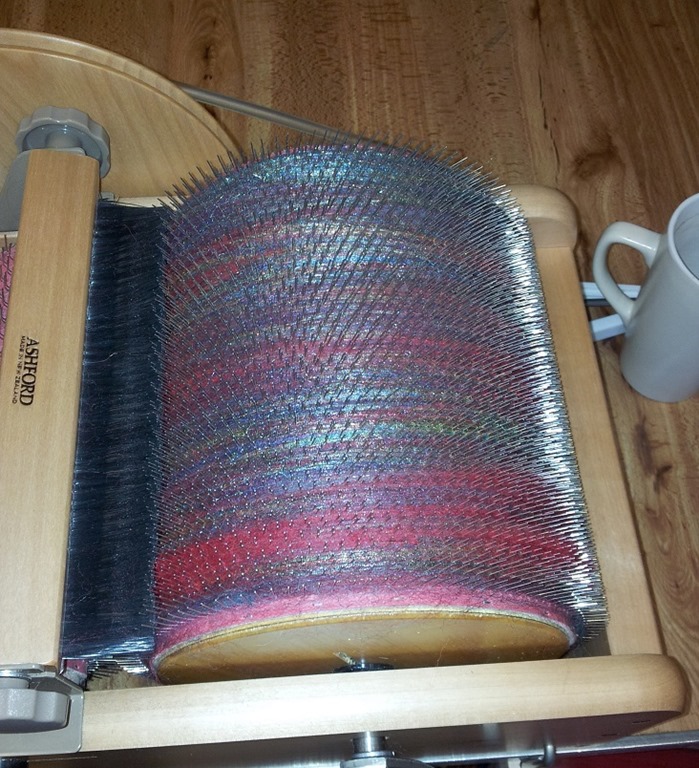
When drum-carding I didn’t use the licker-in at all, I simply turned the drum while applying the tops directly to it. This is the first time I’ve tried this approach.  Sometimes the drum would grab a larger lump of fibre than I desired, but otherwise I was able to fill the drum fairly consistently. A couple of times I did get into a tangle where the licker-in grabbed the tail-end of the tops and started feeding that in as well as the tops I was applying directly to the main drum. (I do hope you’re a spinner and following this. I’ve just realised that I’m talking a special spinner’s language here and perhaps I need to think about a glossary on this blog?)

drum

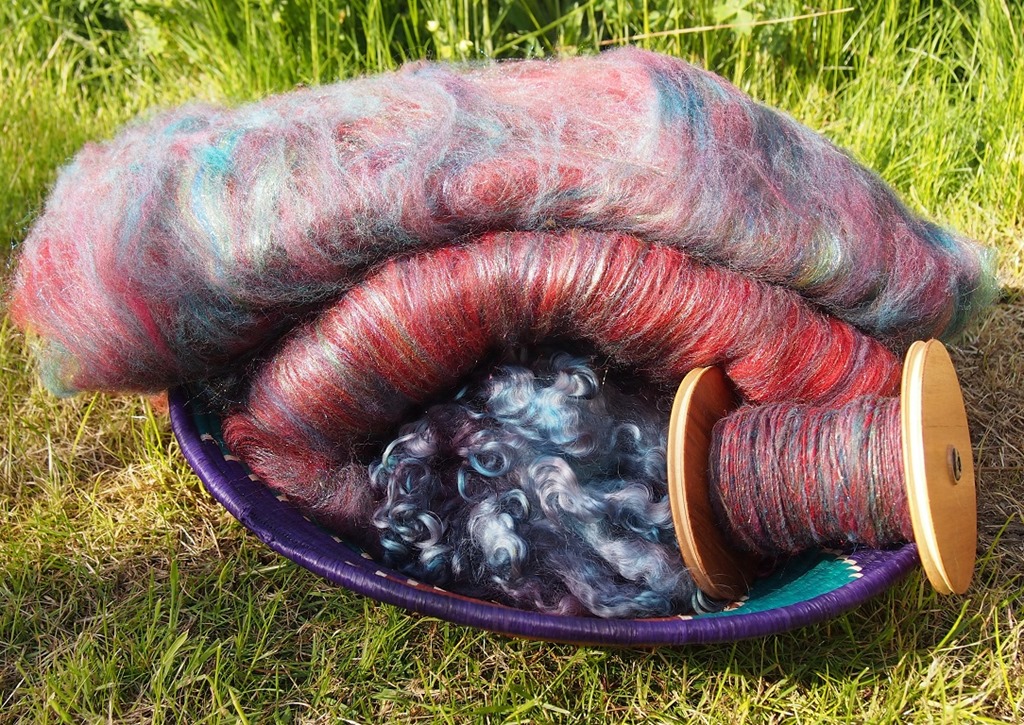
I made four reasonably consistent batts. I didn’t do any blending beyond putting the fibre on in layers (a little like a lasagne: dyed tops, nylon, poppy, dyed, nylon, poppy,…)

batts

I then split the tops lengthways and pre-drafted a little before spinning in a worsted style. There a quite a few lumps and bumps, mostly deliberate (after all this is a wild yarn).

day

The results of a day’s work. I’m planning on Navaho plying and adding the locks of Leicester Longwool at that stage.

Half way there

Before I came home yesterday, I’d finished, washed and dried my first skein of crepe yarn.

Late this afternoon the sun finally popped out from behind the rain clouds that have kept us indoors for much of the day.  I grabbed my skein and my camera and put a pretty book and the skein on top of the stacks of paperwork and books that seem to have migrated to the part of my desk I’m trying to keep clear for project photography (it stays clear for about 5 minutes, then gets invaded by the usual junk all over again).  So I added the macro lens to my camera and tried to hide the junk.

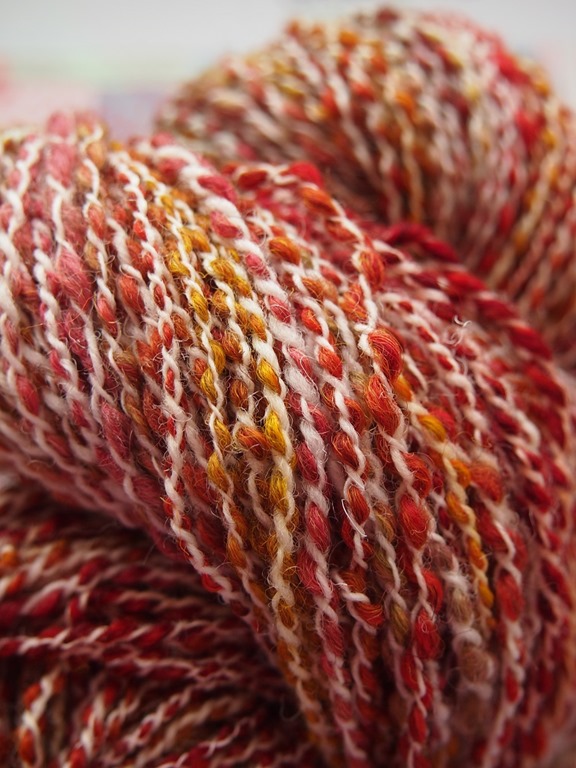
crepe yarn

I’m fairly happy with this as a first skein of rickrack yarn.  It’s a long way from perfect, but it’s predominantly balanced and overall the yarn is interesting.  For the first time ever I think I’m going to need to sample this before I decide on an end project.  And there’s still a second skein to complete…

A breather

I have paused from what has turned out to be a mammoth plying task.  I’m working on the last stage of the 3-ply crepe yarn.  I started working at about 8pm this evening, setting up the skein of (deliberately) over twisted 2-ply onto the swift and the thin z-twist single onto the built-in Lazy Kate of this wheel.  I eventually stopped about halfway through the plying at 10:30pm when my neck was starting to feel achy.

setup

When I started the plying I had to fight the wheel while I persuaded it to take up the yarn (all previous spinning on this wheel has had me fighting too strong take-up and having to lace the singles once or twice between the flyer arms to get a reasonably gentle take-up).  I swore when the yarn jumped out of the open flyer hook (there is no orifice on this wheel) and tangled up instead of winding onto the bobbin.  I was worried that working from a skein of yarn from the swift would give me problems, but this has worked well.  Sometimes my single and two ply has got a bit tangled, so next time I’ll set up the swift on my right-hand side instead of behind my wheel.

Anyway, I eventually managed to get a balance between twist and take-up and I started being able to think about the yarn I was producing.  It took quite a while to get the right way to work on this.  I say the right way, but until I’ve washed and set the twist it’s going to be difficult to tell if it’s completely right.  However, the yarn does seem to snap into place when it’s going correctly.  I’m not holding the yarn in the way I would normally when plying (the single I’m holding fairly straight and the 2 ply I’m feeding in at a slight angle).  I’m working at it slowly so that I can control the amount of twist.  This means that I’m taking much longer to ply this yarn than I would normally take.

My yarn is not yet consistent, but as you can see when it’s working it’s very pretty.  I’m looking forward to seeing this washed and set.

yarn

bobbin

Purple Paradise

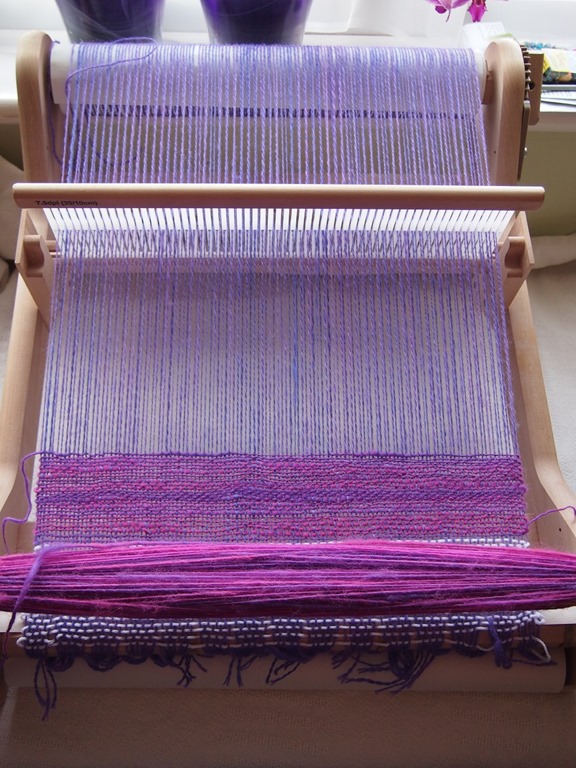
What a terrible name for a shawl.  The name is derived from the names of the tops I handspun and I’m now weaving into a shawl.

One of the yarns is a 2-ply Blue Faced Leicester, that I spun worsted style from hand-dyed tops called Violetta.  The other is a single of Corriedale spun long draw from hand-dyed tops called Birds of Paradise.  I spun these originally nearly 2 years ago!

I’ve tied a 100” (2.5m) warp onto my 16” rigid heddle loom, set at 7.5epi.  I’ve warped up nearly the whole width, leaving just one eye on each end of the loom without a warp thread.  When it came to warping up I wasn’t sure the thread was going to be robust enough and I want to minimise warp threads getting broken.  The rigid heddle has slots and eyes, threads in eyes experience the most stress and wear during weaving. Threads at the selvedge often get drawn in and therefore also experience more stress and wear than other threads.  So I wanted to avoid having a selvedge thread that would experience further wear from also being in an eye.

To further help with wear I’m keeping the tension as low as possible and winding the warp on regularly.  As for an earlier project I’m winding paper onto the front roller when advancing the weaving.  This is helping to keep the tension on the weaving even across the whole work.

I’ve woven about 18” so far and it’s looking good.  The weft thread is fairly slubby, but that’s making the weaving look very interesting.  I’m not too sure how the woven fabric will behave when it’s off the loom as the weft is a fairly active single, so it may collapse.  I’ll have to see what happens!

Here’s progress after tying on the warp and weaving a few picks:

shawl-begun